
Published in the Financial Express on November 30, 2017
There is any doubt that tourism has become industry in the 21st century in the world. Tourism has assumed one of the world’s fastest growing industry which has become a major source of income generation and major foreign exchange earner in many countries in the world. The United Nations World Tourism Organisation (UNTO) defines” tours as the activities of the person travelling to and staying in places outside their usual environment for not more than one consecutive year of leisure, business or other purposes.”
As a result, the United Nations World Tourism Organisation (UNWTO) started celebrating the World Tourist Day on September 27 since 1980. Therefore, Bangladesh has observed world tourist day jointly by the Ministry of Civil Aviation and Tourism, Bangladesh Parjatan Corporation and Bangladesh Tourism Board. According to policy guideline of Bangladesh Parjatan Corporation of 2010, tourism still remains at taking off level in Bangladesh. foreign exchange earnings from tourism sector in 2010 stands at 5562.70 million takas, but World Travel and Tourism Council (WTTC) reported tourism contributed to 296.6 billion taka which covers 1.9 per cent of GDP of Bangladesh in 2014. The World Travel and Tourism Council (WTTC), which was established with 32 business magnates in 1990, promotes awareness about economic contribution made by the travel and tourism industry. According to this Council, the travel and tourism industry in Bangladesh directly generated 1281500 jobs in 2012 which represents 1.8 per cent of the country’s total employment.
The government of Bangladesh plans to make middle income country. Therefore, government should pay more attention to develop tourism as an industry to generate foreign currency. Since mid 70’s several new industries have been developed in Bangladesh. Of which garment industry tops the list within couple of years followed by pharmaceutical, fisheries and ceramic industries.
Bangladesh is multiracial country where Muslims, Buddhists, Hindus and Christians have been residing for centuries and leaving behind many archeological sites of interest to witness indeed. Physiography of Bangladesh has been characterized by two distinct features: a broad deltaic plain, a small hilly region in Chittagong and Chittagong Hill Tracts while low hilly region of Sylhet in the north east. Landmass is made up of fertile alluvial low land known as Bangladesh plain.
Bangladesh inherited rich cultural heritage. The present Bangladesh was a part of ancient Bengal where foreign tourists, including Chinese traveller-historian, Fa-Xien, Tao Lin and Huen-Tsang visited Bengal in fourth and seventh centuries and Buddhist monks of ancient China of Tang dynasty visited the ancient Kingdoms of Samatata, Purnavardhana and Karnsuvarna in 627 AD. Detailed records of these Kingdoms are available in the records of the western regions of the Great Tang dynasty prepared by Monk Xuan Zang. Bengal was flourished during rule of Sultan Giyasuddin Azam Shah of Sonargaon. This has been reflected in writing of Ibn Batuta, the Moroccan traveller, who visited Sylhet to meet Great Sufi Hazrat Shah Jalal and Sonargaon. In fact, Ibn Batuta boarded a Chinese Junk at Sonargaon to travel to Java.
The history of present Bangladesh had been subjected to exploitation and suppression since seventh century when the first trade relations developed with Portugal, France, Holland and the British until 1947.Bangladesh was also exploited by Pakistan when she became part of Pakistan after partition in August of 1947.
The gentle alluvial plains of Bangladesh are the product of three mighty rivers of South Asia: The Ganges, the Brahmaputra and the Meghna while it is commonly divided into three major physiographic units — the hilly and foothill region, the coastal belt and the lower Gangetic plain.
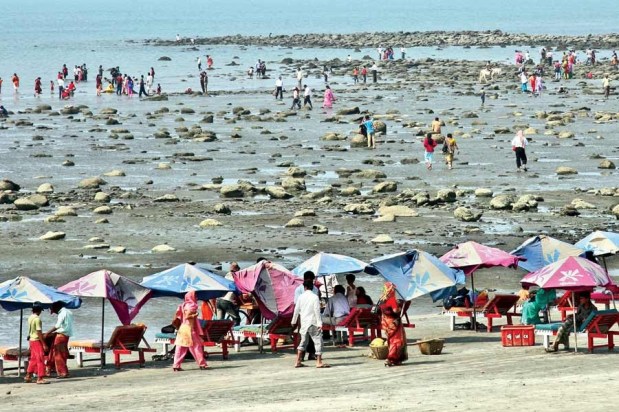
Bangladesh is possibly known to outside world for the longest unbreakable sea beach in the Bay of Bengal in Cox’s Bazar of Chittagong district and the Sundarbans natural forest where Royal Bengal Tigers and spotted Dears are seen. The Sundarbans is having largest amount of bio diversity and largest mangrove forest in the World. UNESCO declared Sundarbans as World Heritage. Another scenic beauty is located at Kua Kata in Patuakhali district. The sea beach at Kuakata is sandy but tourist can have rare view of sunrise and sunset over the Bay of Bengal. Story goes that Rakhine settlers were driven out of Arakan by the Mughals in eighteenth century who settled in KuaKata. They had begun digging on the seashore to get drinking waters. According to Firoz Mahmud, who served as Deputy Keeper of Bangladesh National Museum, discovery of Northern Black Polished Pottery leads to the clue to the earliest known archaeological site of Iron Age in Bangladesh in Mahasthangarh in Bogra while archeological excavation in Mainamati in Comilla provides history of south-eastern Bengal from the seventh to the twelfth century AD.
Possibly many people in Bangladesh are not aware of historical place in Dinajpur district which goes back to Pal and Sen dynasties. Tapan Dighi is situated in the village Tapan. There is myth that King Laxman Sen dug this lake while panoramic view is seen from Sarong Bari forest. Dinajpur Rajbari and Boll Ma Kali temple are worth seeing places in Dinajpur. Except tea gardens in Sylhet tourist may also find interest to see ornate tomb and mosque of Hazrat Shah Jalal, the tiny museum of Rajas containing belongings of local folk poet Hasan Raja and 3-doomed gateway stands at 17th century Shahi Edgah and a huge open-air hilltop mosque built by Emperor Aurangzeb. The sixty Dome mosque which is located at Bagerhat in Khulna which is known as 15th century Islamic edifice. It was established during Tughlaq dynasty in India. UNESCO also declared it as World Heritage. Mausoleum of Fakir Lalan Shah at Seuria in Kushtia is worth seeing place, particularly during Baul songs competition. A great mystic poet and lyricist presented numerous devotional and spiritual songs who died in 1890.A research center was built near the Mausoleum. Rabindranath Tagore collected his many songs and published in Bangla calendar year 1332.
The tourism industry in Bangladesh should be developed as it is lagging behind in competition with neighbouring countries like Nepal and India.
A sense of participation by Bangladeshis themselves in promoting tourism can hardly be overemphasised. Officials at the Ministry of Foreign affairs, the External Resources Division and the Ministry of Labour should be encouraged to know history of Bangladesh and acquaint themselves with historical places in promoting to foreigners during their postings in Bangladesh missions. These officials in fact are totally ignorant of rich cultural heritage of Bangladesh. While serving in Bangladesh Civil Service and Foreign Affairs Academy on deputation from the Ministry of Foreign affairs this writer introduced tours for the newly recruited foreign service officers in 1992. Foreign Service Academy was merged with BSC academy in 1985 by President Ershad on personal grudge against the then principal of Foreign Service Academy. Now Foreign Service Academy has got its status independent again.
There is hardly any need to emphasis to develop infrastructures linking Dhaka, Chittagong, Khulna and Rajshahi with historic places in Bangladesh to facilitate foreign tourist to travel comfortably. Equally important suggestion is that hotel management should consider in consultation with Bangladesh authorities to open casinos and big swimming pool in first class hotels. A big birds cage should be placed along the swimming pools. In this connection, this writer repeat what Somphot Piyaui, Managing Director of 5 star Dusi Thani hotel in Bangkok and proprietor of hundred trolley boats for fishing in Thailand, confided to this writer in first week of March of 1977 while he was on a visit to Bangladesh to open new hotel next to Hotel Intercontinental and joint venture in fishing in the Bay of Bengal to stop piracy by fishermen from Thailand. This writer was told that Malaysia, Egypt and a few other Muslim countries allow Casinos in hotels for foreign tourists which this writer witnessed in Malaysia during diplomatic assignment from 1977 to 1981. Another interesting suggestion came from him was that hotel management should consider importing “moving flower” which means young Thai girls to serve guests in the hotels. Somphot was of the opinion that people from Arab countries would rush to Bangladesh being a Muslim country instead of going to Thailand or other country. That would have opened door for petro-dollar to fly to Bangladesh. Incidentally, Minister of Civil Aviation and Tourism Air-Vice Marshal AG Mahmud, a diehard Muslim, rejected the proposal. This writer was the host officer to two-member delegation from Thailand led by Somphot Piyaui.
Another suggestion is that authorities should ensure with the cooperation of police authorities the safety of tourists in Cox’s Bazar, Kuakata, the Sunderbans and Coral Island in St. Martin in particular. This has become all the more priority in view of series of murder of foreigners, including staff of foreign embassy. The report released by New York based Human Rights watch in July 2017 that at least ninety people were victims of enforced disappearances in 2016 while countless extrajudicial killings and secret detention in Bangladesh placed Bangladesh in an adverse position. Twenty people, mostly foreigners had been killed in an attack on a café at Holey Artisan Bakery in Dhaka on 2 July of 2016 is another adverse circumstance which has caused negative impact on foreign tourist to visit Bangladesh. Therefore, law and order need to be improved in first place to open door to tourists to earn foreign exchange.

 Hossain Blogs