Silk road project of China vis-a-vis Bangladesh

unnamed (2)

Published in the Financial Express on November 12, 2018

The People’s Republic of China has emerged a leading economic power house in the world in the 21st century thanks to it’s the Belt and Road initiative, a signature project of President Xi Jinping. President Xi Jinping’s Belt and Road initiative in fact is the revival of ancient Chinese Silk Road and Trade which got going during the period of Han dynasty from 207BCE (Before Common Era) to 220 BC (Before Christ). At the initial stage the Han dynasty through explorer Ambassador at large, Ziang Qian, expanded the Silk route in Central Asia.

Trade through the Silk route actually played a significant part in establishing civilisation of China. Chinese Buddhist monk Fa Xian, Hui Zi and Hui Da came to ancient Bengal during the fifth century of Han dynasty to learn Buddhist scriptures. Ancient Bengal was also a place the Chinese trade ships sailed to.

During Song and Yuan dynasties Chinese foreign trade further developed. Large quantities of Chinese silk and porcelain were shipped to India, Sri Lanka and Bengal.

In fact, trade had expanded through navigational routes to South and East Asia and East Africa from 1405 to 1433 during the Ming dynasty. Admiral Zheng He, a Chinese Muslim (Cheng Ho) – mariner, explorer and diplomat – had made seven voyages during his lifetime. Zheng He earned appreciation of Emperor Yongle of the Ming dynasty. During the Ming dynasty there were frequent exchanges of envoys between China and Bengal. In 1408 Sultan Ghiyasuddin Azam Shah dispatched an envoy to establish relations with China. The envoy was accorded warm reception by the central government of the Ming dynasty. In 1415 the government of the Ming dynasty dispatched Hou Xian as an envoy to visit Suvarnogram, now Sonargaon near Dhaka, with credentials from Chinese emperor Zhu Di. While calling on the Sultan, the Chinese envoy presented the Queen and the Ministers of Suvarnogram with generous gifts from the Chinese emperor. Zheng He’s voyage team carried from China things including embroidery umbrellas, silk and Satin, porcelain, camphor, gold, silver, copper, etc. Zheng He’s voyage team visited Ceylon, Calicut, the Maldives, Cochin, Koyamyadi and Bengal in 1430. Zheng He did not visit Bengal but his envoy Hong Bao paid a visit to Chattogram and Sonargaon by small boats from Sumatra and presented the Chinese emperor’s imperial manifesto. This writer was associated with a group of journalists of China Pictorial during their visit in 1993 to publish a special supplement on the visit of Zheng He to this part of the world. Journalists from China Pictorial visited Chattogram, Sonargaon and met Chairman of Bangladesh Parjatan Corporation to know about expedition of Zheng He to this part of the world. All arrangements were made by this writer. The team was led by Madam Bian Youfen, Deputy Director of China Pictorial. A special supplement was published on Zheng He voyages in 1994.

From Han to Tang and Ming dynasties there had been trade between China and all South Asian parts plus Central Asia. Chinese silk, silk cloth, paper, Chinese porcelain were very much liked by peoples of this region. As a matter of fact, Chinese beautiful porcelain was preserved at a small museum of Lalbagh Fort in Dhaka which this writer noticed in mid 60’s. UNESCO designated the Chang’ an-Tian Shan corridor of the Silk route as a world heritage site.

China has been emerging economic power house in the world in the twenty first century from an opium-addicted nation in the nineteenth century. It was introduced by the imperial British Raj of East India Company in 1825 by supplying opium and raw cotton in exchange for tea, porcelain and silk.

In 1793, China was known for sophisticated culture and rich history. In 1839 Qing emperor ordered destruction of the large supply of opium stored in China. Commissioner Lin Zexu undertook an expedition to destroy illicit opium and detained the entire foreign community in Guangzhou which in fact led to an “Opium war” between the Chinese and the imperial British. The Chinese lost the war and were compelled to sign the Treaty of Nanjing in 1842. Under this treaty China ceded the Island of Hong Kong to the British while opened five ports to British residence. This treaty was humiliation to China. The treaty was unequal in nature. The Island of Hong Kong was handed over to China on 1st July of 1997 ending 156 years of rule by the British.

The National Committee of the Chinese People’s Political Consultative Conference held in Beijing in June 2017, however, emphasised an anti-corruption campaign in China and building a moderately prosperous society while deepening reform and advancing rule of law and strictly governing the party. China’s economy is targeting a reasonable range of growth between 6.0 and 7.0 per cent.

China President Xi Jinping unveiled the Silk Road Economic Belt concept in September of 2013 during his visit to Kazakhstan wherein he proposed that China and Central Asia cooperate to build a silk road economic belt. The ancient silk route included Samarkand, Bukhara and Ghazni in Central Asia. Therefore, President Xi unveiled his dream project in Kazakhstan. During ancient time, trade caravans moved through cities of Kazakhstan from the border of China and moved to Persia as well.

President Xi Jinping has not only now revived the old silk route but also expanded it to cover Europe as well. International cooperation in the economic field and connectivity were pledged at the two-day Belt and Road forum on May 13-14 in 2017 in Beijing. Twenty nine countries, including Bangladesh participated in the forum despite India’s objection. India which is a part of BCIM- Economic corridor of China delivered an implicit criticism against China because its state-owned companies are working in Pakistan-held Azad Kashmir, the Himalaya region claimed by both sides. It is not understood why the Prime Minister of Bangladesh did not participate in the forum where leaders from Myanmar, Malaysia, Pakistan, Turkey and Russia participated. China in fact has become a major donor country to Bangladesh since establishing diplomatic relations in January of 1976. During the first visit of Chinese President Xi Jinping in 30 years, a loan agreement amounting to $24 billion was signed with Bangladesh in 2016. Prime Minister Sheikh Hasina also visited China three times by now. Bangladesh and China shared defence, economic, political and people to people ties.

President Xi in his keynote paper has spoken of openness, inclusiveness of nations, mutual learning through exchange of knowledge and mutual benefit through flow of goods and people as well. President Xi is of the opinion that China does not want to dictate others but he emphasised economic integration and cooperation in financial regulation, anti-terrorism and security. By implication it means China would play a dominant role. The Chinese President said, “We should foster a vision of common, comprehensive cooperation and sustainable security”. The President announced a total of $113 billion earmarked for the project of Belt and Road. That includes lending $55 billion by two non-commercial Chinese state banks of the amount, $14.5 billion was earmarked for the Silk and Road fund, set up in 2014. Chinese government has also committed to provide financial aid worth $8.7 billion to developing countries and international organisations as well. China established the Asian Infrastructure Investment Bank in 2014 to finance ports, highways and other projects. China had begun construction of railways in some part of Africa, including Bangladesh.

China was awarded a $3.1 billion project contract in 2016 to build a rail network to connect Dhaka with Jashore, a distance of 168 kilometres. It is being designed to run at a speed of 120 kilometre per hour. The rail link project included construction of 66 main bridges, 244 minor bridges plus 14 new railway stations while procuring 100 passenger coaches. China was also awarded a contract to build the Padma Bridge in 2014. The 25-metre-wide and 10-kilometre-long bridge over the River Padma will be built by China’s Major Bridge Engineering Company Ltd at a cost of $1.55 billion in four years’ time. These projects are part of the Belt and Road Initiative. By implication, China maintains the carrot-and -stick policy while doing business under the Belt and Road project.

Political analysts and diplomats are of the opinion that China is trying to create a political clout and an economic network to push the United States out of the region.

Mohammad Amjad Hossain, retired diplomat from Bangladesh and former President of Nova chapter of International Toastmaster club of America, writes from Virginia, USA.

Revival of Cold War scenario will endanger world peace

Revival of Cold War scenario will endanger world peace

Published in the Weekly Holiday on April 18, 2018

The Second Cold War began with the Ukraine crisis. During 1989 and 1990, the Berlin Wall came down; borders opened, and free elections ousted Communist regimes everywhere in eastern Europe. In late 1991 the Soviet Union itself dissolved into its component republics. Since the dissolution of the Soviet Union occurred on December 26, 1991 cold war with western countries came to an end. But aggressive policy adopted by former KGB officer turned politician President Vladimir Putin of Russian Federation, to expand territories to the former Soviet Union he has been isolated gradually from western countries. His first attempt was to interfere in Georgia in 2008 in spite of siding by the United States with Georgia while Russia recognized break away South Ossetia and Abkhazia on the pretext of saving Russians.

Putin also annexed Crimea Peninsula of Ukraine in March of 2014 without firing a shot violating international agreement. These are glaring example indeed in violation of agreements by Russian Federation. In spite of strong protest from western countries President Vladimir Putin did not return Crimea Peninsula to Ukraine which caused him to expel from G-8 industrial group. Relations between United States and Russia further deteriorated during Bush presidency when US recognized breakaway province Kosovo of Serbia on 18 February of 2008 but Kremlin was against recognition of Kosovo.

Instead, President Vladimir Putin has shown his muscle encouraging Russian origin Ukraine to declare autonomous eastern part of Ukraine as separate entity bordering with Russian Federation by assisting them with weapons and dispatching soldiers surreptitiously around the border. As a result, Russia’s membership with NATO stands suspended while some countries around Russian Federation included in NATO instead of protest from Russian Federation. Russia considers expansion of NATO in former Eastern Europe is a violation of western commitment. Russia was in fact incensed when Poland, Hungry, the Czech Republic and Baltic states were joined in NATO in mid 1990.

In spite of adverse trend immediate past President Barak Obama had initiated reset relations with Russian Federation following his meeting with former President of Russian Federation Medvedev in July of 2009 in Kremlin but the invasion of Ukraine and interference in civil war in Syria has spoiled the goodwill shown by President Barack Obama toward Russian Federation.

As of now, President Putin did not suffer serious consequences, but reportedly use of Russian made nerve gas known as Novichok against a double agent of Russia Sergei Skripal and his daughter Yulia Skirpal in London on 4 March of 2018 has caused serious repercussion around the world. Skirpal was arrested in Russia as a double agent in 2004 but settled in London following spy swap in 2010. Kremlin, however, denied the allegation. As a first step Prime Minister of Great Britain Theresa May has expelled 23 Russian diplomats while United States expelled 60 diplomats plus imposed fresh sanctions on 24 Russian firms and individuals to show solidarity with ally of UK. As of now 150 Russian diplomats plus several intelligence officers of Russia were expelled. Being a member of NATO Turkey has refused to follow the footprint of NATO member countries in expelling Russian diplomats. And as many as 23 British diplomats from Russia were expelled as tit for tat tactics.

(Read the Holiday dated March 30, 2018: International page; “Mass expulsion of Russian diplomats from U.S., EU, Canada” by Bill Van Auken).

Similarly, 60 diplomats of the United States faced similar tit for tat tactics by Kremlin. Kremlin also closed down US consulate in St. Petersburg in response to US decision of close down Russian consulate at Seattle. It may be noted that Seattle Russian consulate is near to US major nuclear submarine base and Russian intelligence activities have been noted. A state department spokesperson Heather Nauert is reported to have said on 29 March that we reserve the right to respond because Russia should not be acting like a victim and calling Kremlin’s “move regrettable and unwarranted.”

Having seen the action by Donald Trump administration against Russian Federation it is amazing to note that President Trump himself has made cautious reaction by saying, “the Skripal attack was a very sad situation and said,” it looks like Russians were behind it.” It remains a mystery to notice that President Donald Trump never criticized Vladimir Putin in spite of meddling in presidential election of the United States in 2016 while President Trump appears to have congratulated Vladimir Putin, Russian autocrat on his reelections on 18 March,2018 in spite of objection by his National Security adviser.

There was a popular uprising against Vladimir Putin throughout Russian Federation of his corruption and nepotism before presidential election, apart from jailing opposition leader Alexe Navalny and 15 others in January of this year. Protest rallies in one hundred cities of Russia took place in January. Some journalist and activists are reportedly lost their lives as a result of protests against the administration of Vladimir Putin. Many columnists in the United States reportedly described Putin’s phony election.

Although it is diplomatic successful maneuver by the British administration of Prime Minister Theresa May, but the expulsion of so many Russian diplomats by thirty countries Russia is increasingly isolated. The present scenario against Russian Federation does not speak well for global stability and peace.

The portrait of an ambassador: Anwarul Karim Choudhury

The portrait of an ambassador: Anwarul Karim Choudhury

Published in the Financial Times:  December 9, 2017

Although I have had met Ambassador Anwarul Karim Choudhury on two occasions, I held him in high esteem for his sagacity to pursue diplomacy doggedly and for his personal amiable behaviour. Anwarul Karim Chowdhury had become a spokesperson for the government in exile of Bangladesh in Calcutta following his shifting of allegiance to the latter after quitting the post of third secretary at the Deputy High Commission of Pakistan in Calcutta along with Pakistan Deputy High Commissioner Hossain Ali on April 18 in 1972. For all practical purposes the Deputy High Commission had served as the office of the government in exile of Bangladesh led by Tajuddin Ahmed. The Pakistan government lodged a strong protest with the Indian government following hoisting Bangladesh’s flag at the Deputy High Commission by Ambassador Hossain Ali.

On his return to Bangladesh Anwarul Karim Chowdhury served as Director at the Ministry of Foreign Affairs in mid 70’s along with another stalwart Bangladeshi diplomat K.M. Shehabuddin. Shehabuddin also shifted his allegiance to the government in exile of Bangladesh quitting his post of Second Secretary at the Pakistan High Commission in New Delhi even before the government in exile was formed on April 17, 1972. It was my pleasure to invite both of them, apart from Mr. Akramul Qader, Section Officer who became Ambassador to Thailand and South Africa, to my residence at the city’s Bailey Road to join a farewell dinner before departing for Kuala Lumpur in Malaysia in April of 1977 to join the Bangladesh embassy there as third secretary under High Commissioner Maj Gen K.M. Shafiullah. That was my first interaction with Ambassador Anwarul Karim Chowdhury.

It is really heartening to note that Ambassador Anwarul Karim having served as Bangladesh’s emissary to under-developed countries in Africa was elevated to the position of Permanent Representative of the country to the United Nations from 1996 to 2001. During his tenure at the United Nations, Ambassador Anwarul Karim served as a coordinator of Least Developed Countries for about ten years. As coordinator of the Least Developed Countries he joined the five-member Bangladesh delegation to the G-8 Summit held in Cologne of Germany on June 7-8, 1999. The delegation was led by then Bangladesh Foreign Minister Abdus Samad Azad. This scribe also was one of the members of the delegation from the Bangladesh embassy in Bonn, including Ambassador Kazi Anwarul Masud. During presentation of the viewpoints of LDCs Abdus Samad Azad skipped some important points. Ambassador Anwarul Karim immediately pointed out the lapses. As a troika of the Least Developed Countries, Bangladesh put forth some points seeking commitments from industrially-developed countries to exempt debt burdens of the LDCs. It was a very successful effort as some under-developed countries in Africa were exempted from their debt burdens. The then US President Bill Clinton attended the G-8 summit.

After the summit, the foreign minister accompanied by members of the delegation along with newly-married wife visited the biggest historical cathedral in Cologne and the hilly region of Bonn in Petersburg plateau to have the glimpse of the romantic Rhine Valley of Bonn. Ambassador Anwarul Karim Chowdhury accepted the invitation to have lunch at my official residence in Bonn. The wife of the Foreign Minister was feted by my wife, because the wife of Ambassador Anwarul Masud was away to Bangladesh. That was the second time I interacted with Ambassador Anwarul Karim Chowdhury.

Ambassador Anwarul Karim Chowdhury also served as President of the Security Council, when Bangladesh became a non-permanent member of the Security Council from 2000 to 2001. We got commitment from the German government to support Bangladesh’s candidature for membership of the Security Council. This was the second time Bangladesh became a non-permanent member of the Security Council. From 1979 to 1980 Bangladesh became a non-permanent member of the Security Council for the first time by defeating Japan.

As President of the Security Council Ambassador Anwarul Karim Chowdhury succeeded in establishing the landmark resolution 1325 which reaffirmed the important role of women in prevention and resolution of conflicts, peace negotiation, peace building, peace keeping, humanitarian response and in post-conflict reconstruction and stressed the importance of their equal participation and full involvement in all efforts for maintenance and promotion of peace and security.

Being an amiable personality as a diplomat, Anwarul Karim Chowdhury has made tremendous impact on the international body which was reflected in his appointment as Chairman of the Second Council Committee on Sierra Leone and President of the UNICEF executive board. His leading role resulted in proclaiming by the United Nations the year 2000 as International Year for Cultural Peace and the period of 2001-2010 as the International Decade for a culture of peace and non-violence for the children of the world. Ambassador Anwarul Karim also led as a UN culture of peace emissary in May of 2010, because peace efforts continuously failed until people embraced humanity’s oneness.

Ambassador Anwarul Karim Chowdhury also served as High Representative of UN for the Least Developed Countries, Land Locked developing countries, Small Island developing states in March of 2002. From 1990-1993 Ambassador Anwarul Karim served as Director of UNICEF in Japan, Australia and New Zealand. Possibly Ambassador Anwarul Karim Chowdhury is the only Bangladeshi diplomat who got the honour of receiving the U Thant peace award, UNESCO Gandhi Gold medal for culture of peace while the Japan government conferred on him an honorary doctorate degree for his work on women’s issue, child rights and culture of peace and strengthening the United Nations. The government of Burkina Faso decorated him with the country’s highest honour L’ordre Nacionale on January 18 2007 for championing the cause of the most vulnerable countries.

Ambassador Anwarul Karim received Doctor of Humane Letters honoris causa degree from Saint Peter’s University of the United States of America in 2012 and served as an adjunct professor at the school of diplomacy at Seton Hill University of the USA. He is the founder of the New York-based Global Movement for culture of peace while he is the founding Co-Chair of the International Ecological Safety collaborative Organisation (IESO) with its headquarters in China.


Emerging tourism industry in Bangladesh

Emerging tourism industry in Bangladesh

Published in the Financial Express on November 30, 2017

There is any doubt that tourism has become industry in the 21st century in the world. Tourism has assumed one of the world’s fastest growing industry which has become a major source of income generation and major foreign exchange earner in many countries in the world. The United Nations World Tourism Organisation (UNTO) defines” tours as the activities of the person travelling to and staying in places outside their usual environment for not more than one consecutive year of leisure, business or other purposes.”

As a result, the United Nations World Tourism Organisation (UNWTO) started celebrating the World Tourist Day on September 27 since 1980. Therefore, Bangladesh has observed world tourist day jointly by the Ministry of Civil Aviation and Tourism, Bangladesh Parjatan Corporation and Bangladesh Tourism Board. According to policy guideline of Bangladesh Parjatan Corporation of 2010, tourism still remains at taking off level in Bangladesh. foreign exchange earnings from tourism sector in 2010 stands at 5562.70 million takas, but World Travel and Tourism Council (WTTC) reported tourism contributed to 296.6 billion taka which covers 1.9 per cent of GDP of Bangladesh in 2014. The World Travel and Tourism Council (WTTC), which was established with 32 business magnates in 1990, promotes awareness about economic contribution made by the travel and tourism industry. According to this Council, the travel and tourism industry in Bangladesh directly generated 1281500 jobs in 2012 which represents 1.8 per cent of the country’s total employment.

The government of Bangladesh plans to make middle income country. Therefore, government should pay more attention to develop tourism as an industry to generate foreign currency. Since mid 70’s several new industries have been developed in Bangladesh. Of which garment industry tops the list within couple of years followed by pharmaceutical, fisheries and ceramic industries.

Bangladesh is multiracial country where Muslims, Buddhists, Hindus and Christians have been residing for centuries and leaving behind many archeological sites of interest to witness indeed. Physiography of Bangladesh has been characterized by two distinct features: a broad deltaic plain, a small hilly region in Chittagong and Chittagong Hill Tracts while low hilly region of Sylhet in the north east. Landmass is made up of fertile alluvial low land known as Bangladesh plain.

Bangladesh inherited rich cultural heritage. The present Bangladesh was a part of ancient Bengal where foreign tourists, including Chinese traveller-historian, Fa-Xien, Tao Lin and Huen-Tsang visited Bengal in fourth and seventh centuries and Buddhist monks of ancient China of Tang dynasty visited the ancient Kingdoms of Samatata, Purnavardhana and Karnsuvarna in 627 AD. Detailed records of these Kingdoms are available in the records of the western regions of the Great Tang dynasty prepared by Monk Xuan Zang. Bengal was flourished during rule of Sultan Giyasuddin Azam Shah of Sonargaon. This has been reflected in writing of Ibn Batuta, the Moroccan traveller, who visited Sylhet to meet Great Sufi Hazrat Shah Jalal and Sonargaon. In fact, Ibn Batuta boarded a Chinese Junk at Sonargaon to travel to Java.

The history of present Bangladesh had been subjected to exploitation and suppression since seventh century when the first trade relations developed with Portugal, France, Holland and the British until 1947.Bangladesh was also exploited by Pakistan when she became part of Pakistan after partition in August of 1947.

The gentle alluvial plains of Bangladesh are the product of three mighty rivers of South Asia: The Ganges, the Brahmaputra and the Meghna while it is commonly divided into three major physiographic units — the hilly and foothill region, the coastal belt and the lower Gangetic plain.

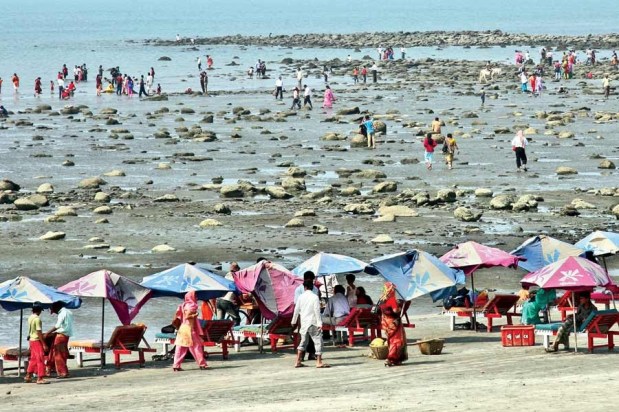
Bangladesh is possibly known to outside world for the longest unbreakable sea beach in the Bay of Bengal in Cox’s Bazar of Chittagong district and the Sundarbans natural forest where Royal Bengal Tigers and spotted Dears are seen. The Sundarbans is having largest amount of bio diversity and largest mangrove forest in the World. UNESCO declared Sundarbans as World Heritage. Another scenic beauty is located at Kua Kata in Patuakhali district. The sea beach at Kuakata is sandy but tourist can have rare view of sunrise and sunset over the Bay of Bengal. Story goes that Rakhine settlers were driven out of Arakan by the Mughals in eighteenth century who settled in KuaKata. They had begun digging on the seashore to get drinking waters. According to Firoz Mahmud, who served as Deputy Keeper of Bangladesh National Museum, discovery of Northern Black Polished Pottery leads to the clue to the earliest known archaeological site of Iron Age in Bangladesh in Mahasthangarh in Bogra while archeological excavation in Mainamati in Comilla provides history of south-eastern Bengal from the seventh to the twelfth century AD.

Possibly many people in Bangladesh are not aware of historical place in Dinajpur district which goes back to Pal and Sen dynasties. Tapan Dighi is situated in the village Tapan. There is myth that King Laxman Sen dug this lake while panoramic view is seen from Sarong Bari forest. Dinajpur Rajbari and Boll Ma Kali temple are worth seeing places in Dinajpur. Except tea gardens in Sylhet tourist may also find interest to see ornate tomb and mosque of Hazrat Shah Jalal, the tiny museum of Rajas containing belongings of local folk poet Hasan Raja and 3-doomed gateway stands at 17th century Shahi Edgah and a huge open-air hilltop mosque built by Emperor Aurangzeb. The sixty Dome mosque which is located at Bagerhat in Khulna which is known as 15th century Islamic edifice. It was established during Tughlaq dynasty in India. UNESCO also declared it as World Heritage. Mausoleum of Fakir Lalan Shah at Seuria in Kushtia is worth seeing place, particularly during Baul songs competition. A great mystic poet and lyricist presented numerous devotional and spiritual songs who died in 1890.A research center was built near the Mausoleum. Rabindranath Tagore collected his many songs and published in Bangla calendar year 1332.

The tourism industry in Bangladesh should be developed as it is lagging behind in competition with neighbouring countries like Nepal and India.
A sense of participation by Bangladeshis themselves in promoting tourism can hardly be overemphasised. Officials at the Ministry of Foreign affairs, the External Resources Division and the Ministry of Labour should be encouraged to know history of Bangladesh and acquaint themselves with historical places in promoting to foreigners during their postings in Bangladesh missions. These officials in fact are totally ignorant of rich cultural heritage of Bangladesh. While serving in Bangladesh Civil Service and Foreign Affairs Academy on deputation from the Ministry of Foreign affairs this writer introduced tours for the newly recruited foreign service officers in 1992. Foreign Service Academy was merged with BSC academy in 1985 by President Ershad on personal grudge against the then principal of Foreign Service Academy. Now Foreign Service Academy has got its status independent again.

There is hardly any need to emphasis to develop infrastructures linking Dhaka, Chittagong, Khulna and Rajshahi with historic places in Bangladesh to facilitate foreign tourist to travel comfortably. Equally important suggestion is that hotel management should consider in consultation with Bangladesh authorities to open casinos and big swimming pool in first class hotels. A big birds cage should be placed along the swimming pools. In this connection, this writer repeat what Somphot Piyaui, Managing Director of 5 star Dusi Thani hotel in Bangkok and proprietor of hundred trolley boats for fishing in Thailand, confided to this writer in first week of March of 1977 while he was on a visit to Bangladesh to open new hotel next to Hotel Intercontinental and joint venture in fishing in the Bay of Bengal to stop piracy by fishermen from Thailand. This writer was told that Malaysia, Egypt and a few other Muslim countries allow Casinos in hotels for foreign tourists which this writer witnessed in Malaysia during diplomatic assignment from 1977 to 1981. Another interesting suggestion came from him was that hotel management should consider importing “moving flower” which means young Thai girls to serve guests in the hotels. Somphot was of the opinion that people from Arab countries would rush to Bangladesh being a Muslim country instead of going to Thailand or other country. That would have opened door for petro-dollar to fly to Bangladesh. Incidentally, Minister of Civil Aviation and Tourism Air-Vice Marshal AG Mahmud, a diehard Muslim, rejected the proposal. This writer was the host officer to two-member delegation from Thailand led by Somphot Piyaui.

Another suggestion is that authorities should ensure with the cooperation of police authorities the safety of tourists in Cox’s Bazar, Kuakata, the Sunderbans and Coral Island in St. Martin in particular. This has become all the more priority in view of series of murder of foreigners, including staff of foreign embassy. The report released by New York based Human Rights watch in July 2017 that at least ninety people were victims of enforced disappearances in 2016 while countless extrajudicial killings and secret detention in Bangladesh placed Bangladesh in an adverse position. Twenty people, mostly foreigners had been killed in an attack on a café at Holey Artisan Bakery in Dhaka on 2 July of 2016 is another adverse circumstance which has caused negative impact on foreign tourist to visit Bangladesh. Therefore, law and order need to be improved in first place to open door to tourists to earn foreign exchange.

Down the memory lane: Remembering Ambassador Nazrul Islam

A brilliant officer of Pakistan foreign service cadre joined Bangladesh foreign ministry on repatriation from Pakistan as Chief of Protocol in 1973 to replace Arshaduzzaman who was appointed Ambassador to Algeria. During his tenure as Chief of Protocol large number foreign dignitaries visited Bangladesh to see the newly emerged independent country following a bloody war of liberation.

The most important of those visitors was President Josef Broz Tito of Yugoslavia, who was one of the founder members of Non-Aligned Movement along with Pundit Jawaharlal Nehru of India, Soekarano of Indonesia and Gamal Abdel Nasser of Egypt. Yugoslav president was accompanied by a 90 member delegation, including foreign minister, defence minister and political secretary to the president. Josef Broz Tito and his personal staff members stayed in Bangabhavan while his ministers and other members of the delegation stayed in the state guest houses. The visit took place from 24-29 January 1973. This writer was in the foreign ministry’s external publicity division as an Assistant Director and his services used to be requisitioned by the Chief of Protocol when such dignitaries visited Bangladesh. During the visit I was located at Padma guest house as host officer to look after the delegation’s needs. I came to know from the Yugoslav defence minister that Tito’s birth day was on 26 January. To give him a surprise I arranged with guest house caretaker Harris to send a bouquet of flowers through the Yugoslav President’s political secretary Alexander Sarkorak next morning while he left for the Bangabhavan to say to the Yugoslav a happy birth day. For a few second he kept quiet and thanked me profoundly and invited me to visit Belgrade as his guest.

This event was reported to Chief of Protocol Nazrul Islam by Yugoslav President’s political secretary. After the departure of Yugoslav delegation Nazrul Islam gave briefings on the conduct of officers and arrangement made by the government. Nazrul Islam praised me eloquently for my initiative to give the bouquet of flowers to the most powerful man in Tito’s administration.

During the visit Tito invited Prime Minister Sheikh Mujibur Rahman to attend Non-Aligned summit in Algeria from 5-9 September of 1973.

The second important visitor was Pakistan’s prime minister Zulfiqar Ali Bhutto, who came at the invitation of Bangladesh Prime Minister. During his visit I was again requisitioned by the Chief of Protocol and was posted at Bangabhavan. At one time the Chief of Protocol rushed to my allotted room and instructed to book a call to Sylhet Deputy Commissioner and ask him to find Kaiser Rashid Chowdhury, former foreign service officer who served as Private Secretary to Mr. Zulfiqar Bhutto when he was the foreign minister and send him to Dacca to participate in the talks with Bangladesh as instructed by Prime Minister Sheikh Mujibur Rahman. Kaiser Rashid Chowdhury was attending the Kul Khani of his mother in Sylhet.

However, Kaiser Rashid Chowdhury flew to Dacca by next available Biman flight. Talks between Bangladesh and Pakistan were not successful on the question of asset sharing and taking back the Biharis from Bangladesh who opted for Pakistan.
Another important visitor was President Leopold Senghor of Senegal, a well known poet and statesman, from May 26—29 of 1974. I was placed as Protocol officer at Banghabavan as I spoke French. In his speech President Senghor praised Sheikh Mujibur Rahman for his steadfast courageous role for Bangladesh which had made him an institution. During state banquet I was assisting Madam Senghor. At the end of the visit President Leopold Senghor presented me a copy of his book: Nocturnes.

Chief of Protocol Nazrul Islam initiated letter of appreciation by Foreign Minister Dr. Kamal Hossain for working as protocol officers during the visit of a number of foreign dignitaries. I was one of the officers received appreciation letter from Foreign Minister Dr.Kamal Hossain. Nazrul Islam was in the habit of inviting me to accompany for lunch at his residence. On reaching the house his first duty was to enquire about his ailing mother if she was given medicine on time.

Incidentally, Nazrul Islam was a very good chess player. A chess board always remained on his desk in the office and whenever he managed some free time he tried to concentrate on a game of chess.

While serving as Ambassador in Kuwait, he was called back to headquarters to serve as Foreign Secretary in place of Mr. Fakhruddin Ahmad, who was in disagreement with President Gen. Ershad. Nazrul Islam joined on 9 May of 1987 as Foreign Secretary. During his tenure I was posted as First Secretary to Bangladesh embassy in Bucharest, Romania in July of 1987. In 1987 I was assigned to work in West Asia desk of Foreign Ministry because President Ershad decided to merge external publicity division of the foreign ministry with the ministry of information. That was another ill advised decision by President Ershad and it was reversed after he was deosed.

While I was serving as Deputy Director in Civil Service cum Foreign Service academy in Shahbagh in 1992, Nazrul Islam retired from foreign office. Actually, President Ershad had merged Foreign Service Academy with Civil Service Academy because of his personal grudge against then Principal of the Foreign Service Academy.

I decided to invite Ambassador Nazrul Islam for a talk on foreign policy for the benefit of the newly recruited foreign service officers. Nazrul Islam accepted my invitation and the officers who attended had appreciated his style of discussions. There was an evaluation system of guest lecturers by the newly recruited officers in the academy. This was strictly followed during the administration of Dr. Sadat Hossain, Director –General of Academy who retired as Chairman, Public Service Commission of Bangladesh.

While at the academy, I organized a seminar on climate change for the benefit of newly recruited foreign service officers in consultation with Dr. Fazlul Hasan Yusuf, Diector-Gerneral of the Academy who incidentally worked in Foreign Ministry at initial stage of the Ministry. Professor M. Aminul Islam of Geography Department of Dacca University presented the key note paper while Professor Dr. Ainun Nishat of Bangladesh University of Engineering and Technology and Dr. Atiq Rahman, Director, Bangladesh center for advanced studies were the discussants. Ambassador Nazrul Islam, former Foreign Secretary, presided.

While serving as Director in Europe desk in 1994 Ambassador Nazrul Islam used to drop in my office to have a chit chat over a cup of tea. Possibly in his mind he was thinking of serving as the country’s foreign minister which may have prompted him to join the Bangladesh Nationalist Party like Ambassador Rezaul Karim. Nazrul Islam had been maintaining a close liaison with his constituency when he was the foreign secretary. Similarly, Ambassador Rezaul Karim also maintained close touch with his Kushtia District after retirement.

Unfortunately, neither Ambassador Rezaul Karim, nor Ambassador Nazrul Islam succeeded in getting nominations from the BNP to contest election. Ambassador Nazrul Islam expired on 23 April of 1999. Although some of his colleagues in the Ministry called him an eccentric but he was humane and in fact was a humorous person. May Allah bless him in heaven.

Diplomats’ role during liberation war of Bangladesh

Published in the Weekly Holiday on April 07, 2017.

Diplomacy is the first defence while war is the second defence of the country’s sovereignty. The role of diplomats played in mobilizing public opinion around the world from April of 1971 following Pakistan army’s crackdown on unarmed people in erstwhile East Pakistan which is separated from Western part of Pakistan about 1200 miles over Indian territory. The role played by diplomats would be written in red letter the history of Independent Bangladesh.
Defection of Bangladeshi diplomats in Pakistan embassies around the world mobilized public opinion against Pakistan’s atrocities and genocidal activities in what was then East Pakistan. Even American diplomat, in particular, Archer Blood, American Consul-General in Dacca, who relentlessly highlighted the events in Bangladesh in his diplomatic cables though they were met with deafening silence in Washington.

Defections of Bengali diplomats
Eventually Blood lost his job in the State Department at the instigation of Henry Kissinger, National Security advisor under President Richard Nixon and Secretary of State to President Gerald Ford. Gary J Bass in the book: ‘The Blood Telegram’ which reflected the moral bankruptcy of US leaders, pointed out that Archer Blood was not allowed to protest to the Pakistan authorities but started sending in a blistering cables tagged selective genocide, urging his bosses to speak out against atrocities being committed by the Pakistani military regime.

On 6 April most staff members of the Dhaka American Consulate practically revolted against the Nixon administration by sending telegram “for silence in the face of atrocities”. Archer Blood is no more in this world but US embassy in Dhaka established a library in Archer Blood’s name to show respect. He was source of information to BBC and other news agencies for disseminating information at a time when Military government of Pakistan bundled 36 foreign correspondents out of Dhaka on 28 March 1971. He was recalled a few months later.

This is one side of story of the diplomats. On the other hand, Pakistan’s President Gen. Yahya Khan’s faith retaining unified Pakistan was shattered when 14 diplomats posted in Pakistan embassy in Washington, including present Finance Minister AMA Muhith, declared allegiance on 5 August, 1971 to the government of Bangladesh in exile. The declaration of allegiance had caused serious repercussions in Islamabad. That was reflected in the briefing session of the officers by Dr. Maqbool Bhatti, Director-General of External Publicity and National affairs on 16 August where this writer was present.

How Kolkata mission created
The Director General only regretted and wished them well as some Senior Bangladeshi diplomats were his batch mate in foreign service, and said that situation would be normal soon in East Pakistan. I was the only Bengali officer amidst the Punjabis and Sindhis present. Another Bengali officer Ezrajul Alam from Press Information department was appointed on an ad hoc basis a few months early. This writer left Islamabad on 27 August on leave via Karachi and Colombo in Sri Lanka because India had disallowed air traffic to overfly to Dhaka. This writer did not join after expiry of leave in November, 1971.

In fact the ball began to roll at the Pakistan Deputy High Commission in Calcutta (now Kolkata) when as many as 60 diplomats and non-diplomats under the leadership of Pakistan’s Deputy High Commissioner Hossain Ali declared allegiance to Bangladesh government in exile on 18 April. It happened just a day after the Bangladesh government in exile was formed under the leadership of Mr. Tajuddin Ahmad, an unsung hero.

Deputy High commissioner Hossain Ali’s decision was important as it facilitated Bangladesh government in exile to use the High Commission office as its secretariat. Hossain Ali also made history by hoisting Bangladesh flag in the chancery. Both Deputy High commissioner and third secretary Mr. Anwarul Karim Chowdhury worked tirelessly as spokespersons of Bangladesh government in exile. Pakistan government lodged protest to Indian government and sought assistance for repatriation of diplomats to Pakistan but without any success.

This was an all-time record in the history of diplomacy when diplomats and officials defected en masse to an emerging country. Second secretary Mohiuddin Ahmed from London defected on April 10 who was the first diplomat from London’s Pakistan embassy.

Top Bengali ambassadors joined
The name of Khwaja Mohammad Kaiser may be mentioned in this context who served as Pakistan Ambassador to China who remained in his post at the advice of the Bangladesh government in exile who repatriated to Bangladesh some time in 1972. Ambassador Kaiser was a close friend of Chinese Prime Minister Chou En Lai who gave him farewell dinner in his honor. Ambassador Abul Fateh was in Iraq as Pakistan Ambassador. Ambassador K.K. Panni from Manila and Ambassador Abdul Momen from Argentina defected as well. Pakistan government sent warrant of arrest against Ambassador Abul Fateh, who withdrew entire amount of twenty five thousand pounds from Embassy’s bank account and gave to Bangladesh government in exile through Indian Ambassador in Iraq.
The first in the series of defection began with K.M. Shehabuddin, Second Secretary and Amjadul Haq, Assistant Press Attache in New Delhi followed by A.H. Mahmood Ali in New York who is now serving as Foreign Minister of Sheikh Hasina’s Awami League government.

Among the high ranking diplomats, who declared their allegiance for Bangladesh, names of Abdul Fatah, Abdul Momin, K.K Panni and Abdul Momen are worth mentioning. All of them were holding Ambassadorial assignments.
Officially, the first Bangladesh mission was set up in Calcutta on 18 April, 1971 when Bengali diplomats stopped normal functioning at Pakistan Deputy High Commission and converted it into Bangladesh mission. It was followed by an Information Centre in New Delhi on 26 April with K.M.Shehabuddin as its chief.

Abu Sayeed Chowdhury, others
On December 06, 1971 Bangladesh government in exile decided to open trade missions in USSR, Romania, and Czechoslovakia etc. to establish commercial relations with different countries until Bangladesh is recognized by international community. The Government of India gave green signal to operate Bangladesh Trade Mission from Calcutta. That was indeed a success story of diplomacy in pre-liberation days.

The role played by Justice Abu Sayeed Choudhury, after quitting the position of head of Pakistan delegation to the United Nations Human Rights Commission in Geneva, was very effective indeed. Justice Abu Sayeed along with Bengali diplomats in different parts of the world played a significant role in mobilizing public opinion against genocide and in favour of recognition of Bangladesh. The role of first Foreign Secretary Mahbubul Alam Chashi, who resigned in protest from Pakistan Foreign service during the regime of Gen. Ayub Khan, has many caps to his credit in dealing with foreign policy during crucial days of Bangladesh. It would be unfair to ignore the role of Iqbal Ather, a Pakistani diplomat, who resigned in protest from Ambassadorship in Italy against repressive measures in erstwhile East Pakistan. Iqbal Ather joined the diplomatic corps of the newly independent Bangladesh and contributed towards improving the image of Bangladesh along with Ambassador Ataur Rahman in Arab and African countries.