
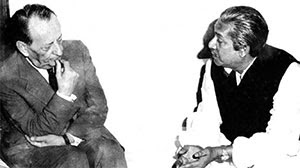
THE PEOPLE of Bangladesh should forever remember André-Georges Malraux, an intellectual giant and humanist of the twentieth century, for his outstanding contribution towards the Liberation War of Bangladesh. André Malraux was given honorary citizenship by Bangabandhu Sheikh Mujibur Rahman, then Prime Minister of Bangladesh, during his visit from 23 – 24 April, 1973.
The French philosopher, novelist, warrior and statesman was also received by President Justice Abu Sayeed Chowdhury, who in praise of Malraux’s humanitarian role said that “Malraux’s love for humanity and cherished ideals never admitted any geographical barrier and his bold voice was heard across the world whenever human dignity was in danger.” Chief of Protocol Arshad-Uz-Zaman, a linguist, organized his trip to Chittagong and Rajshahi.
A civic reception was organized in Chittagong while the Rajshahi University coferred Doctorate of Literature on Malraux. This writer accompanied André Malraux to Chittagong in a helicopter on 21 April. Apart from according civic reception André Malraux had the pleasure of opening art gallery of the Chittagong University where French speaking renowned artist Rashid Choudhury was a professor.
Civic reception was conducted by Dr Mahmud Shah Qureshi, a Professor of Bengali at Chittagong University who was fluent in French. André Malraux had a cruise in Kaptai Lake on a house boat of industrialist and former Minister of Pakistan for industry A. K. Khan, who gave a lunch in his honor on the boat.
 |
| Andre Malraux aboard a helicopter in Chittagong with writer of the article. |
On his return to Dacca André Malraux also met a cross section of people from civic society, including freedom fighters who were wounded during the war of liberation. André Malraux met them at Suhrawardy Hospital where he became emotional. This writer also accompanied him to the hospital. André Malraux was also treated to lunch by Foreign Minister Dr.Kamal Hossain at his official residence on 22 Aprilwhere among others, writer-poet Abu Zafar Mohammad Obaidullah Khan, then Joint Secretary, was present.
Bangladesh was his second homeland
In his Rajshahi trip my colleague Esrajul Alam and Akramul Qader (who became Bangladesh Ambassador to the US in 2011 after retirement having served as Ambassador to Thailand and South Africa) accompanied him. In Rajshahi, at a special convocation André Malraux said, “On your own tombs there are perhaps souvenir of the words justice and liberty with which the generals of the revolution had put Europe to flame.” During conversation with this writer Malraux described Bangladesh as his second homeland.
Malraux favoured guerilla war
Monsieur André Malraux in a letter to esteemed Indian leader Jay Prakash Narayan, a Gandhite and revolutionary politician said, “What matters is the military organization of Bangladesh. Either it will accept pitched battles with Pakistan and will be wiped out or it will organize its guerillas and Pakistan will be defeated”. This letter was in response to an invitation to attend international conference on Bangladesh held in New Delhi from 16-17 September of 1971.
Malraux also wrote a letter to President Richard Nixon immediately after Pakistan army massacred the innocent people in Bangladesh to exercise his good offices on Pakistan to stop genocidal killings. Apart from this, Malraux proposed formation of an international brigade to fight for the cause of oppressed people in erstwhile East Pakistan but did not materialized as he was successful in forming such International Brigade during Spanish civil war in 1930 along with European intellectuals and ordinary people as well.
Literary and political career
Novelist, art historian, and statesman who became an active supporter of Gen. Charles de Gaulle and, after de Gaulle was elected president in 1958, (1901 – 1976) served for 10 years as France’s minister of cultural affairs. His major works include the novel La Condition humaine (1933;Man’s Fate); Les Voix du silence (1951; The Voices of Silence), a history and philosophy of world art; as well as Le Musée imaginaire de la sculpture mondiale(1952–54; Museum Without Walls).
As a story goes Novel: Georges by Alexandre Dumas and Macbeth of Shakespeare influenced his mind. As a bohemian Malraux was seen in cinema, theater halls, exhibitions and museums and developed a fascination for music. He also had the privilege of meeting renowned artistes like Picasso, Braque, Mark Siegal with whom he built up friendship over the years. Malraux had a name for entertaining his friends in a restaurant where discussion on arts, music, cinema and politics dominated. Malraux was also contributor to such newspaper which were branded as left-leaning, but incidentally he did not subscribe to views of those newspapers. Politically he was non-committal while absorbed philosophical thinking and giving aesthetic solutions to problems. Gradually he developed friendship with celebrated writes of his time.
André Malraux has had difficult time during his visit along with fiancé Clara Goldschmidt, a Jewish by birth, to Florence in Italy to see rich cultural heritage from where Clara Goldschmidt sent a message to her mother that she was betrothed.
In Saigon Malraux brought a newspaper along with Paul Monin, a lawyer, to denounce colonial attitude of French government. While editing newspaper Malraux wrote a number of articles on occidental culture and left Saigon on 30 December of 1925. During second world war Malraux joined French army and fought in the battle field but captured twice by the enemy. Incidentally, Malraux escaped from the hands of the enemy. He was awarded the French military decoration” Croix de guerre” for his heroic act involving combat operation against enemy.
Malraux’s mistreatment in jail by the French colonial authorities turned him into a fervent anticolonialist and an advocate of social change. While in Southeast Asia he organized the Young Annam League (the precursor of theViet Minh, or Viet Nam League for Independence), became a leading writer and pamphleteer, and founded a newspaper, L’Indochine Enchaînée (“Indochina in Chains”). Crossing to China, he apparently participated in several Chinese revolutionary incidents and may possibly have met Mikhail Borodin, the Russian communist adviser to Sun Yat-sen and then to Chiang Kai-shek.
Malraux was to return to East Asia several times. In 1929 he made important discoveries of Greco-Buddhist art in Afghanistan and Iran. In 1934 he flew over the Rub al-Khali in Arabia and discovered what may have been the site of theQueen of Sheba’s legendary city. Though he was captivated Paris with his exceptional intelligence, lyrical prose, astonishing memory, and breadth of knowledge, it was not generally appreciated that his true life was elsewhere than in the literary salons or on the committee of La Nouvelle Revue Française or at literary congresses.
As fascism, in the shape of Nazism, rose in the 1930s, Malraux recognized its threat and presided over committees pressing for the liberation of the international communists Ernst Thälmann and Georgi Dimitrov from their imprisonment under the Nazis. He simultaneously eschewed a rigid Marxism, participated in the Ligue Nationale Contre l’Antisémitisme (National League Against Anti-Semitism), and in 1935—before the world in general had learned that concentration camps existed—published Le Temps du mépris (Days of Wrath), a short novel describing the brutal imprisonment of a communist by the Nazis. At the same time, he began to write his Psychologie de l’art (3 vol., 1947–50; The Psychology of Art), an activity that bore a relationship to his other interests, for to Malraux aesthetic ideas, like the philosophy of action expressed in his own novels, would always be part of man’s eternal questioning of destiny and his response to it.
Upon the outbreak of the Spanish Civil War in 1936, Malraux went to Spain, joined the Republican forces, and organized for them an international air squadron, becoming its colonel. After flying numerous aerial missions at the front, he visited the United States in order to collect money for medical assistance to Spain. His novel L’Espoir (Man’s Hope), based on his experiences in Spain, was published in 1937. A motion-picture version of L’Espoir that Malraux produced and directed in Barcelona in 1938 was not shown in France until after the country’s liberation at the end of World War II.
His first novel that appeared in 1928 was “Conquerors” followed by another novel: “The Royal way” in 1930.In fact both novels depicted his experiences in Cambodia. In 1933 Malraux was honored with Prix Goncourt for his masterpiece novel: La Condition Humaine. French President General De Gaulle appointed him as Minister for Information in 1945 and he became Minister for Cultural affair in 1958.
Malraux during his long charismatic chequered career associated himself with the field of literature, war, adventure, politics, cinematorgraphy and came into contact with noted personalities like Gorki, Einstein, Mao Tse Dong, Léopold Sedar Senghor—-President and Poet of Senegal and Pandit Nehru.
The world lost a humanist and an intellectual giant at his death at the age of 73 on November 23 of 1976. At his death the Government of Bangladesh commented: “The death of Monsieur Malraux removed from the world scene a literary giant, a humanist par excellence, who championed and fought for the cause of the oppressed. We in Bangladesh will always cherish his memory; his clarion call in defense of our war of Independence was heard around the globe.”
This writer suggests that a road be dedicated in his name where Pakistan’s vanquished army surrendered on 16 December of 1971.
 Hossain Blogs