
Published in the Financial Express on October 31, 2017
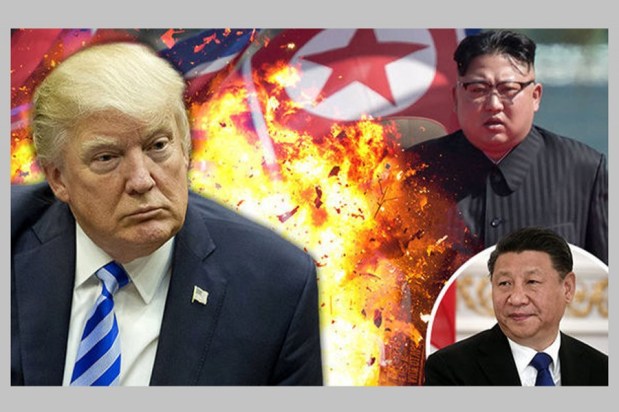
Donald Trump will undertake his first visit to Asia, as the President of the USA, from November 03 to November 14. As announced by the White House, President Trump, accompanied by First Lady Melanie, will make a 12-day visit to Japan, South Korea, China, Vietnam and the Philippines to persuade the leaders of these countries to put pressure on North Korea to curb its nuclear weapons programme and make the region a demilitarised zone.
Trump will apparently face difficulties in pursuing this goal in view of his past stance. He exchanged inflammatory insults with North Korean leader Kim Jung-Un and criticised President of South Korea Moon Jae-in for his conciliatory gesture towards North Korea and his readiness to hold dialogue with his northern neighbour. Trump threatened to cut trade deal with China which has already backfired.
Kim Jung-Un did not abandon nuclear weapons programme despite new economic sanctions imposed by the UN on North Korea following its sixth launching of nuclear device in the first week of September.
Foreign policy of North Korea took the present shape following NATO’s bombing of Serbia in 1999, in total disregard of the 1995 Dayton agreement to put an end to the three-and-a-half-year-long Bosnia war. Kosovo declared independence after the attack of Serbia by NATO with the instigation of the United States. Germany also joined in the chorus for the first time after its constitutional court allowed its armed forces in 1993 to participate in fighting outside Germany. The negative precedent set by NATO in Kosovo makes North Korea distrust the United States.
Another negative example was set by NATO and US when they bombed Libya as the Libyan leader Muammar Qaddafi gave up nuclear programme.
Against this backdrop, former President Jimmy Carter, who is now 93, has expressed his willingness, during talks with Park Han-Shik, a Professor of International Relations at Georgia University, in September this year, to mediate between the United States and North Korea to avert a nuclear war and save the world from any catastrophic disaster. President Jimmy Carter had been to North Korea in 1994 to negotiate with Kim Il-sung, grandfather of Kim Jung-Un, as an envoy of President Bill Clinton to shore up denuclearisation talks. In 2010, Jimmy Carter again visited North Korea to negotiate release of a jailed American.
In spite of a request by the White House to keep his mouth shut, President Jimmy Carter in an article to the Washington Post on October 04 wrote that, the North Korean situation is the “most existential threat to the world peace and ask to implore Washington and Pyongyang to find a peaceful way to ease the escalating tension and reach a lasting peaceful agreement.” Jimmy Carter obviously wants to finish the task of denuclearisation of the Korean Peninsula without having a second Korean war.
During his Asian tour, President Trump will also attend Asia-Pacific Economic Cooperation (APEC) summit in Vietnam, apart from the summit of the Association of South East Asian Nations (ASEAN) in Manila.
ASIAN SCENARIO: Meanwhile, Trump has threatened to walk away from the 2015 international nuclear agreement with Iran. If he carries out his threat, it will be a disaster indeed. Iran would be placed on carte blanche to resume nuclear activities without constraint. Trump’s national security team, including Secretary of State, Defence Secretary and Chairman of Joint Chief of Staff, supported the 2015deal. Meanwhile, Iran has expanded its sphere of influence in Iraq after the fall of Saddam Hussein, Syria, Lebanon and to some extent in Bahrain where majority population are Shiites. Russia is assisting Iran while Turkey, only Muslim country in NATO alliance, also joined hand with Iran following declaration of vote for independence by leader of Kurdish autonomous region in North of Iraq.
In Asia, China has become leading military and economic power. By renewing old Silk Road diplomacy China has expanded its sphere of influence in Asia. Similarly, Russia has also joined hands with China in the region, apart from Russia’s Eurasian economic union.
As for Afghanistan, President Trump’s strategy would not succeed by deploying more troops. Cooperation between Pakistan and Afghanistan is a sine quo non-to stop Taliban rebellion. Over the last 16 years, war in Afghanistan has become the longest and costliest operation of the army of the United States. By now major portion of Afghanistan is under control of Taliban. Quadrilateral Coordination Group, which comprises of Afghanistan (including Taliban), China, Pakistan and United States, should be revived to pave the way for peace in Afghanistan.
It will be interesting to watch the development in Asia following the visit of the continent by President Trump, against the backdrop of a tense situation in the Korean peninsula over the nuclear programme of North Korea.
 Hossain Blogs