
Published in the Financial Express on January 6, 2018
The coldest-ever weather and President Donald Trump’s twitter message hinting at pursuing a coercive foreign policy in the days ahead heralded the new year of 2018 for the United States.
In his twitter message on January 02 Trump apparently meddled in the internal affairs of Iran in the wake of the on-going protests by the Iranian people against the ruling regime. He has given full support to anti-government protests throughout Iran blaming former President Obama’s policies, saying corruption of Iran’s leadership has been fueled by the benefits of the nuclear deal negotiated by Obama administration. He also suggested he could compel US allies to reimpose sanctions against Iran. As a matter of fact, nuclear deal with Iran is an international agreement among five permanent members of the UN Security Council plus Germany. Therefore, it will not affect if United States goes alone against the deal.
At a press briefing, Trump’s Press Secretary Sarah Sander on January 03 said that the White House’s unyielding support for the demonstrators contrasted to the more reticent approach taken by Obama administration in 2009 during protests that became known as the Green Movement. Tens of thousands of Iranians participated in demonstrations in Iran to demand higher wages and to end corruption, apart from questioning the wisdom of Iran’s foreign policy in the Middle East where millions of dollars are being spent. By now, 23 Iranians got killed and hundreds have been put behind the bars. However, President Hassan Rouhani of Iran criticised some actions of the government, which indicated that some of the demands of the protesters were legitimate.
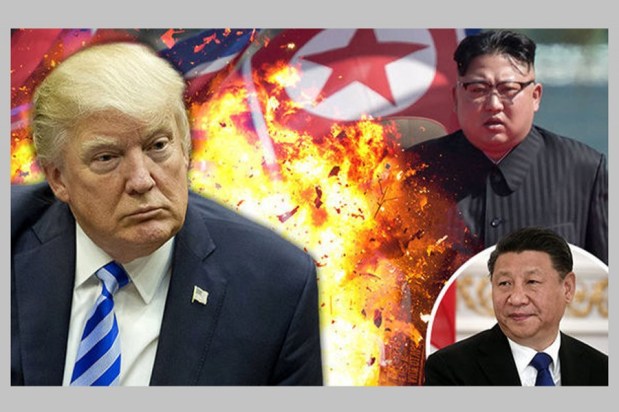
Another drama has unfolded over the issue of nuclearisation of North Korea under the very nose of President Trump. North Korean Leader Kim Jong Un has caused a stir the other day by saying that he had the nuclear button on his desk and that the entire United States was within its range, but he would not initiate attack unless North Korea faced any threat of attack. On the other hand, President Donald Trump in a twitter message on January 02 said that he too has his nuclear button on his desk, and it is more powerful and the button works. In fact, US President has no button on his desk unless he is authorized by the Congress to declare war.
Meanwhile, in a televised New Year message Kim Jong Un has made a conciliatory move to have dialogue with South Korea, an ally of the United States in Korean Peninsula. Presidential spokesperson from South Korea welcomed the proposal to hold talks about the Winter Olympic to be held in South Korea. Winter Olympic would be held in Pyeongching, a city about 50 miles off from the border dividing the Korean peninsula.
A dramatic development has taken place on another front. This relates to Pakistan. President Trump declared to cut foreign aid to Pakistan, amounting to $255 million, to punish Pakistan for the alleged ‘deceit and fraudulent tactics’ adopted by it with regard to terrorist organizations. Trump said “the United States had foolishly given Pakistan more than $33 billion in aid over the last 15 years, and they have given us nothing but lies and deceit, thinking of our leaders as fools. They gave safe haven to terrorists we hunt in Afghanistan….” Pakistan, on the other hand, said the remark by US leadership was completely incomprehensible as it contradicted facts.
Since President Trump’s declaration of Jerusalem as the capital of Israel, reaction from around the world has gone wild against him. As of now, only Guatemala has agreed to go along with the US decision to shift its embassy from Tel Aviv to Jerusalem. Now, President Trump in a twitter threatened to cut aid to Palestine in view of President Mahmood Abbas’s threat to disassociate Trump administration from negotiation on the Palestine-Israel issue. While threatening to cut aid, Trump said there was no reason why Washington should make any of the ‘massive future payments’ when the Palestinians were no longer willing to talk peace. It may be recalled that Mahmood Abbas said in Paris on December 23 that Palestinians would not accept any peace plan from the United States, while French President Macron declared that the US had marginalized itself in Israel-Palestine conflict. Having seen US President’s coercive diplomacy, Israel is making another unilateral move towards tightening its grip on Jerusalem. Israeli Parliament enacted a law on January 02 in this regard, while Israel’s ruling party unanimously voted to apply the law to Jewish settlers in the West Bank. PLO secretary general Saeb Erekat, who was the main negotiator with Israel in recent days, criticized President Trump of dictating negotiation.
Meanwhile, US ambassador to the United Nations Nikki Haley threatened to slash funding to the United Nations Palestine Refugee Agency (UNRWA) if the Palestinians refused to engage in peace negotiations. Established in 1949, UNRWA has been providing financial assistance to Palestinian refugees in Lebanon and Jordan, in particular. It is funded by voluntary contributions of the member countries of the UN as well as of individuals.
 Hossain Blogs