
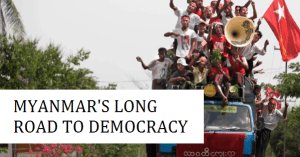
 The people of Myanmar gave their verdict in the November 8 general election and have brought into being the process of democracy in 25 years through a free and fair election marked by sporadic violence, intimidation and voting fraud. As announced by the Election Commission, the National League for Democracy (NLD ) of Suu Kyi, a Nobel laureate for peace, won landslide victory in the lower house of parliament. Since the assassination of Gen Aung San in 1947, founder of modern Burma, who succeeded to liberate Burma from the subjugation of Imperial Japan and the British, the country had plunged into the hands of military junta. Gen Aung San was the father of Suu Kyi.
The first free and fair election in 1990 had seen the NLD winning the polls but the military junta did not recognise its results. The country went back to square one and leader of NLD Suu Kyi was interned in the house for an indefinite period. Several hundred political activists of the party were jailed. Freedom of speech and free press remained suspended. Torture on minority communities in Myanmar continued unabated. Persecution of Muslim Rohingya, one of the oldest minorities in Myanmar, was unprecedented.
In mid-80s, Suu Kyi joined politics to bring back democracy in Myanmar. She became a vocal critic of the military junta but without any effect.
Suu Kyi is a fragile but a very determined personality. Dr Michael Aris, her husband, could not join her wife in Rangoon when his cancer was detected because the Burmese authorities did not give him visa. Similarly, Suu Kyi did not accept their offer to go to London. She thought that the military junta would not allow her to enter Yangon. Her husband expired in 1999.That was a great sacrifice by Suu Kyi for democracy. She enjoyed the pinnacle of glory when she was declared recipient of the Nobel Peace Prize in 1991 and her husband received the award in Norway on her behalf.
Having seen the results, the ruling Union Solidarity and Development Party congratulated Suu Kyi’s party for its landslide victory and assured that they would join the NLD for talks towards national reconciliation next week. It is heartening to hear that the military-backed government assured ‘to respect the country’s election results. Practically, the NLD would have a difficult time to change any law in parliament because the amended constitution of Myanmar of 2008 reserves 25 per cent seats for the military in the upper and lower houses. It also bars Suu Kyi from becoming President of Myanmar.
The country of 51 million had long been isolated from the international community under the repressive military junta. The credit for holding the present free and fair election in Myanmar goes to the US administration of President Barack Obama. The US was practically bent upon seeing the county become liberated from the military junta and conduct political reforms. In 2010, the military junta, led by Gen Thein Sein, released Suu Kyi from house arrest and other political prisoners gradually and relaxed restrictions on internet accesses and censorship. This was followed up by the visit of US secretary of state Hillary Clinton and President Obama as well. In fact, Obama visited Myanmar two times. The US administration also withdrew economic sanctions and provided $500 million in aid.
It would be interesting to watch reconciliation talks between the NLD and the ruling Union Solidarity and Development Party. Freedom of speech, free press and offering citizenship to persecuted Rohingya Muslims must be ensured and all political prisoners should be released without any condition. We hope the situation of 1990 would not be repeated this time and the country would be back to the path of democracy.
Published in the Friday, November 13, 2015 Financial Express
 Hossain Blogs